
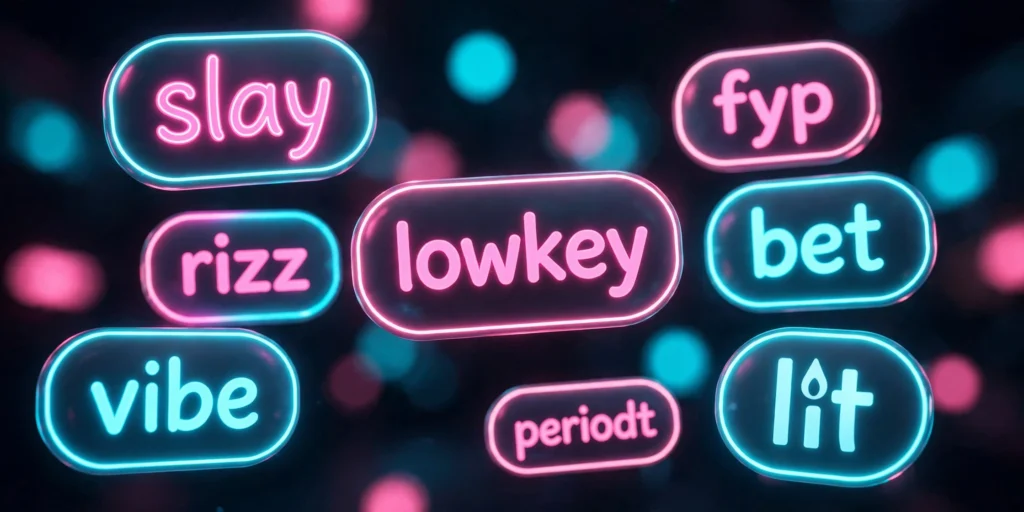
TikTok slang is the fast-moving vocabulary born in TikTok videos, captions, and comment sections — and in 2026 it shapes how millions of people talk both online and off. If you have ever felt lost reading a comment section, you are not alone. Below are the 15 TikTok slang words you will see most this year, each with a plain-English meaning and a real example sentence.
Why TikTok Slang Moves So Fast
TikTok’s algorithm rewards novelty, so a phrase from one creator’s video can become global vocabulary within days. A sound goes viral, the comments invent a shorthand for the joke, and suddenly millions of people are using a word that did not exist last week. No other platform compresses the journey from inside joke to mainstream speech quite like this.
The comment section is the real engine. TikTok comments are a competitive sport — the funniest, sharpest comment gets pinned by likes — and that pressure breeds new language constantly. Words get shortened, remixed, and stress-tested in real time. The ones that survive are short, flexible, and funny enough to travel.
That is also why TikTok slang can feel overwhelming: you are not learning a fixed dictionary, you are catching up with a moving target. The 15 terms below are the ones that stuck around long enough to matter. Learn them and you will understand the vast majority of what you read in comments this year.
It is worth remembering that this speed is new. Before TikTok, slang mostly traveled through music, movies, and friend groups — a journey that took months or years. Now a teenager in Ohio can coin a phrase on Monday and hear a teenager in London using it by Friday. The pace is the point: on TikTok, language is content, and content never sits still.
The 15 TikTok Slang Words Everyone Uses in 2026
1. SYBAU
SYBAU stands for “shut your bitch ass up” — a blunt, dismissive interjection used to shut down an argument or roast a friend. It is rude by design, so it lives in casual spaces: group chats, gaming lobbies, and heated comment threads where nobody is pulling punches.
“You’re still going on about that? SYBAU.”
Because it is genuinely harsh outside friend groups, it is worth knowing exactly when not to use it. Our SYBAU breakdown covers the tone, the origins, and the comeback generator for when the group chat gets heated.
2. Rizz
Rizz means charm — specifically, skill in flirting or attracting people. It is short for charisma, and it spawned its own family of spin-offs: W rizz (it worked), L rizz (it did not), rizzler (a charming person), and unspoken rizz (charm without words).
“He walked up and got her number in two minutes — the rizz is unreal.”
3. No Cap
No cap means “no lie” — it is used to emphasize that you are being honest or serious. Its opposite is “cap,” which means a lie. You will often see it backing up a bold claim.
“No cap, that’s the best concert I’ve ever been to.”
4. Sus
Sus is short for suspicious or suspect, describing behavior that seems shady or off. It exploded through the game Among Us, where players constantly accused each other of being “sus,” and it never left the vocabulary afterward.
“He’s been acting sus ever since he got that text.”
5. Bet
Bet means “okay,” “agreed,” or “got it” — a casual way to confirm plans or accept a challenge. It is the verbal equivalent of a nod, and it works in almost any low-stakes situation.
“Meet at seven? Bet.”
6. Slay
Slay means to do something exceptionally well, especially with style or confidence. It started in drag and ballroom culture long before TikTok found it, then conquered the mainstream as the go-to compliment for a great performance or outfit.
“She slayed that presentation — the whole room was clapping.”
7. NPC
NPC stands for “non-player character” — a gaming term for background characters, now used (usually teasingly) for people who seem to follow the crowd without thinking for themselves. It stings because it implies someone is not really playing the game of life.
“He just repeats whatever everyone else says. Total NPC behavior.”
8. Touch Grass
Touch grass means go outside and reconnect with reality — it is advice, or an insult, for someone who spends too much time online. It is the internet’s way of prescribing fresh air.
“You’ve been arguing in the comments for three hours. Go touch grass.”
9. Yap
Yap means talking too much, usually about nothing important. Calling someone a yapper is telling them to wrap it up. It often shows up in debates about podcasts and streamers who never seem to stop talking.
“He’s been yapping about his fantasy team for twenty minutes.”
10. Ratio
Ratio describes what happens when a post’s replies outnumber its likes — usually a sign the take was unpopular. Replying “ratio” to someone is itself a dunk, a way of saying the numbers have already settled the argument.
“Two thousand replies and forty likes? That’s a brutal ratio.”
11. Glow Up
Glow up means a major positive transformation, usually in looks, style, or confidence. Before-and-after glow up posts are an entire genre, and the phrase is pure encouragement — nobody uses it as an insult.
“Her glow up from freshman year to now is actually insane.”
12. Mid
Mid means mediocre or underwhelming — not terrible, just not worth the hype. It is the internet’s favorite faint praise, and it gets applied to everything from movies to meals to entire albums.
“The movie was mid. Good effects, boring story.”
13. Delulu
Delulu is short for delusional, usually describing an unrealistic crush or fantasy — and it is often used affectionately about oneself. Being “delulu” is practically a lifestyle on stan TikTok.
“I’m delulu enough to think he’ll notice me in a crowd of ten thousand.”
14. Ate
Ate means performed flawlessly — “she ate” is high praise for an outfit, a performance, or a moment. The past tense is the whole point: the job is done, and done well. Its cousin “ate and left no crumbs” means the same thing with extra emphasis.
“Did you see her outfit at the awards? She absolutely ate.”
15. Ick
Ick is the sudden feeling of repulsion toward someone you were attracted to, triggered by one small thing — the way they laugh, how they chew, a weird text. The ick is famously irrational and famously irreversible.
“He was cute until he started chewing with his mouth open. Instant ick.”
How Slang Spreads on TikTok
The pipeline is remarkably consistent. A creator coins or popularizes a phrase in a video — sometimes intentionally, often by accident. If the phrase is funny and flexible, other creators start using it in stitches, duets, and their own videos. The algorithm, which rewards watch time and engagement, pushes the most entertaining versions onto millions of For You pages. Within days, the phrase jumps from videos to comments to everyday speech.
Sounds and memes accelerate everything. A viral sound can carry a slang term across language barriers, and comment sections act as a laboratory where meanings get refined. Users test variations, argue about definitions, and vote with likes. The winning version is usually the shortest and most versatile one — which is why so much TikTok slang is one or two syllables long.
Mainstream media and brands usually arrive last, and their arrival is often the beginning of the end. Once a term shows up in a corporate ad campaign, younger users start treating it as dated. That is the cycle: born on TikTok, raised in the comments, retired by marketing departments. The terms in this list survived because they are useful enough to outlast the hype.
Meanings also shift as terms travel. A word that starts as a compliment in one community can become sarcastic in another, and regional twists appear constantly — the same term might carry a slightly different flavor in UK comments versus US ones. That is normal for living language. If a definition here ever feels slightly off from what you are seeing, trust the context you are seeing it in; slang belongs to the people using it, not to any dictionary.
How to Use TikTok Slang Without Embarrassing Yourself
Two rules. First: context is everything. Most of these terms are casual-only, and some are genuinely rude outside friend groups — SYBAU, for example, will end a conversation fast if you aim it at the wrong person. Know your audience before you deploy the vocabulary, and when in doubt, keep the edgier terms in the group chat.
Second: don’t force it. Slang used self-consciously is worse than no slang at all — everyone can tell when you are performing. The natural way to learn is immersion: lurk in comment sections, watch how creators use the terms, and let the usage sink in before you try it yourself. Give it a week of observation and the right moments will start presenting themselves.
Want definitions with real examples and tone guides? Our slang dictionary breaks down the biggest terms with origins and usage notes — plus a comeback generator for when the group chat gets heated.
Frequently Asked Questions
What is the most popular TikTok slang in 2026?
There is no single winner — slang varies by community. But terms like rizz, no cap, sus, and delulu have the widest recognition, while newer coinages rise and fall every few weeks. The list above focuses on the terms with the most staying power this year.
Why does TikTok slang change so fast?
The algorithm rewards novelty, so creators constantly invent fresh language to stand out. Combined with millions of users remixing phrases in comments, a new term can go from one video to global vocabulary in days — and burn out just as quickly when the next one arrives.
Is it okay to use TikTok slang at work or school?
Most TikTok slang is casual-only and does not belong in professional or formal settings. Milder terms might slip into friendly workplace chat, but anything rude or edgy — SYBAU included — should stay in personal conversations with people who know your sense of humor.
How can I keep up with new TikTok slang?
Spend time in comment sections and watch a variety of creators — that is where new terms surface first. Slang dictionaries and explainers like this site help too, but nothing beats seeing words used in real context by real people.
Do older generations use TikTok slang too?
Often, yes — usually a year or two after a term peaks with younger users. When parents and brands start using a word, it is typically a sign the term has gone fully mainstream and is on its way to sounding dated among its original audience.